






PHOTO: Housing markets are bubbling all over the world
- Economists diverge on how property downturn will hit consumers
- Most are in RBA camp of cautious optimism; some more worried

Economists agree Australia’s housing prices are about to sink. What they’re not so aligned on is just how much a slide in the country’s A$10 trillion ($6.9 trillion) property market will drag the economy down with it.
With interest rates rising and inflation yet to peak, few expect an economy that’s 60% fueled by consumption to escape unscathed from a housing correction. While some economists are talking of recession, others expect Australia’s consumers to withstand the reversal of a wealth effect that accelerated during the pandemic.

The disparity in views underscores the delicate balancing act that Reserve Bank Governor Philip Lowe must perform as the central bank seeks to quickly tame inflation that’s plaguing economies worldwide. Housing slowdowns driven by tightening cycles can have an outsized impact on broader economic growth as households cut spending to repay their mortgages, and Australia’s central bank is forecast to hike rates at the fastest pace on record.
Here’s a look at the optimistic and pessimistic scenarios for Australia’s economy as its housing market cools.

The Bullish Case
Optimistic analysts cite solid underlying economic momentum with unemployment at a near 50-year low of 3.9%, high job vacancies and still resilient consumer spending as reasons the economy will withstand a slide in home prices.
By comparison, during the previous property downturn in 2017-2019, unemployment hovered at 5-5.5% while household savings were less than half of what they are today.
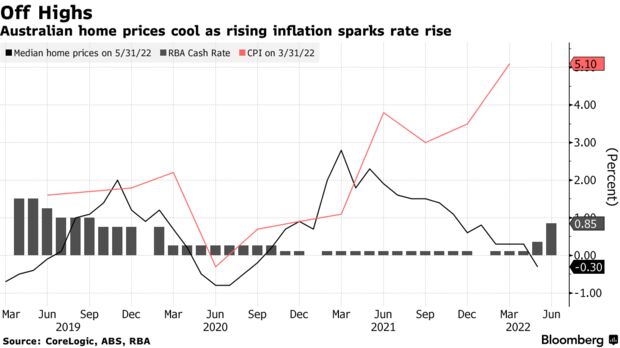
Since January, home prices in the bellwether Sydney market have declined 0.9%, while the nationwide value saw its first decline in June since 2020. Australia & New Zealand Banking Group Ltd. economists predict Sydney prices will drop one-fifth by the end of next year.
Bloomberg Intelligence sees prices in the nation’s largest city falling 12-15% in 2022, based on the cash rate climbing to 1.75% by December.
Leading the cautious optimists is Governor Lowe, who has raised interest rates twice since May to 0.85% and is widely expected to move again in July. While he acknowledges that rapid hikes will trim the financial buffers amassed by the country’s indebted households over the past couple of years, he sees reasons to be positive.
“We’ve got more financial assets as well as A$200 billion of extra savings, that’s a lot of money,” Lowe said in Sydney last week. “There are a lot of kind of moving pieces here, but where we stand today, household spending has been pretty resilient.”
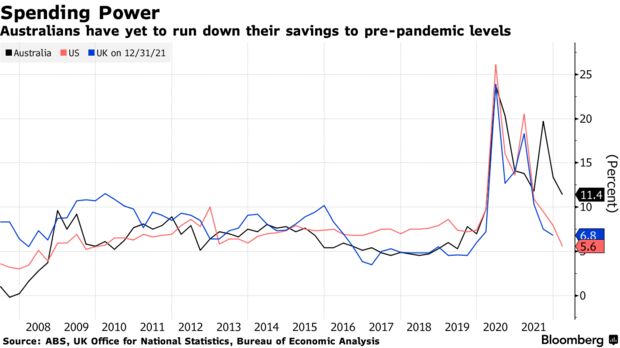
Among other reasons why most economists aren’t panicking are recent data showing that Australian businesses’ investment plans are the strongest in more than a decade, firms are still hiring hard and household savings are above 11% of income.
Job vacancies also remain high, with data Thursday coming in at 13.8% for the three months through May, more than double the previous quarter.
READ MORE VIA BLOOMBERG
MOST POPULAR IN NEW ZEALAND
 New Zealand house prices predicted to CRASH in 2022 | WATCH
- Real estate agent whose wife died on their honeymoon when he crashed their island buggy breaks his silence | WATCH
- Inland Revenue takes action on real estate agents
- What is blockchain and what does it mean for real estate? | REINZ
- IR applies to put two more companies linked to Nikki Connors into liquidation
- REAL ESTATE AGENTS: Cox Partners rebrand to Tremains
- ANZ “pauses” low-equity lending
- Real estate agent kidnaps hiking couple
- Celebrity chef Ganesh Raj ‘s Tasting Shed owes $1M to the IRD | WATCH
- WARNING: New Zealand property at top of risk ranking | Bloomberg


