




PHOTO: A neglected problem at the core of Australia’s property market is causing increasingly disastrous consequences, new research shows.
A dearth of social and affordable housing in Australia is costing communities tens of millions of dollars per year, and placing a “time bomb” at the heart of our economy.
That is according to new analysis from Dr Andy Nygaard, an Associate Professor at Swinburne University of Technology’s Centre for Urban Transitions.
Dr Nygaard’s research suggests insufficient investment in social and affordable housing is now costing the national economy a whopping $676.5 million in foregone social and economic benefits each year.
And that cost is set to keep growing, to as much as $1.286 billion by 2036.
The thrust of the analysis is that a lack of affordable housing doesn’t just hurt the people who can’t buy or rent homes. It harms society as a whole.
For example, a lack of housing leads to more homelessness. And more homelessness creates a higher burden on the public health system.
Another example: if a victim of domestic violence has nowhere to go, he or she is more likely to remain trapped, unable to escape an abuser. This adds to the burden on the justice system.
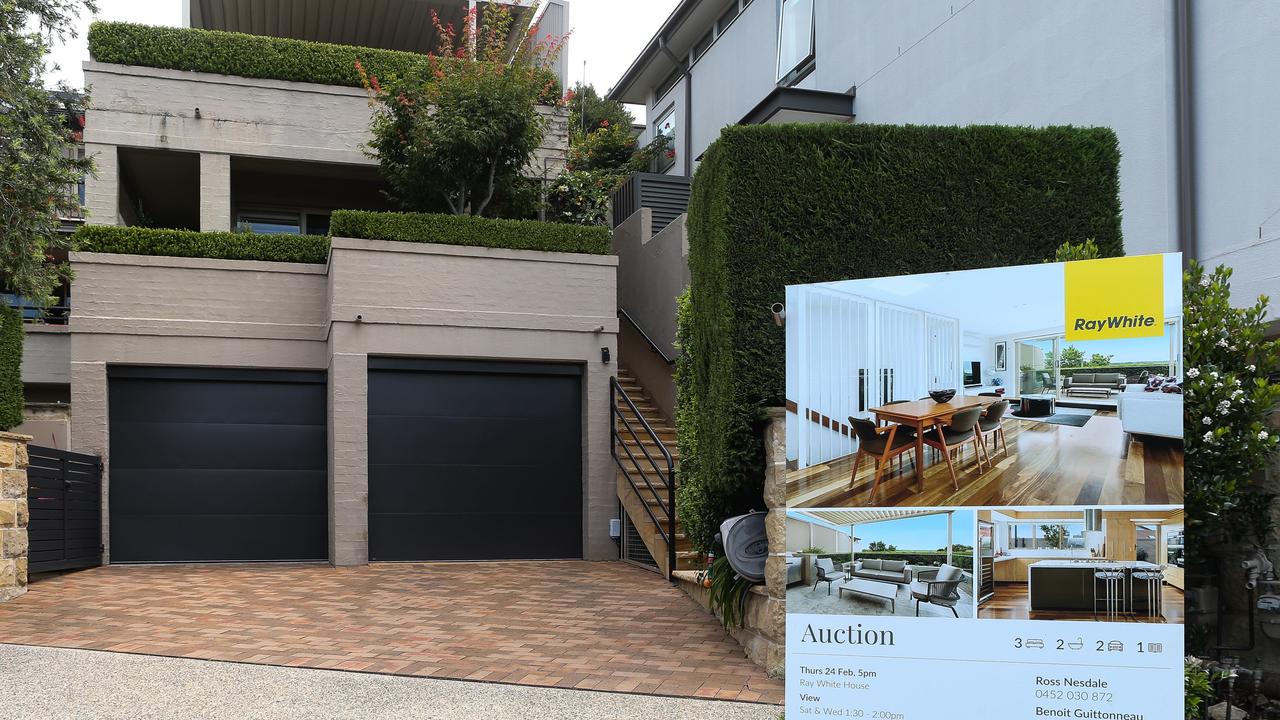
A property for sale in Sydney. Picture: Gaye Gerard/NCA NewsWire
Dr Nygaard sought to quantify the price these problems carry for Australian communities.
“These costs cannot be ignored,” he said.
“The social and economic problems associated with our affordable housing shortage will only increase over the next decade if we keep doing what we have been doing – very little.
“In the absence of additional investment, communities are going to see considerable strain on homeless shelters, police, hospitals and other public services.
“Households will have less to spend on children’s wellbeing and education. Employers may also feel the cost of increased absenteeism.”
To arrive at his conclusions, Dr Nygaard took a suite of factors into account, including: the public sector health costs associated with homelessness, stress and depression; the health and justice system costs caused by domestic violence; reduced disposable income; and the private sector costs associated with stress and depression.
His modelling identifies which communities are currently paying the worst price.
At the top of the list is Sydney’s inner south west, with a cost of $28.2 million in 2020, which could grow as high as $52.5 million in 2036.
The Gold Coast is in second with a figure of $27.9 million, growing to $45.6 million, followed by inner Melbourne with $22.9 million, rising to $51.2 million.
Rounding out the top ten are Parramatta, Tweed, west Melbourne, the city and inner south of Sydney, the Sunshine Coast, southeast Melbourne and the outback in the Northern Territory.
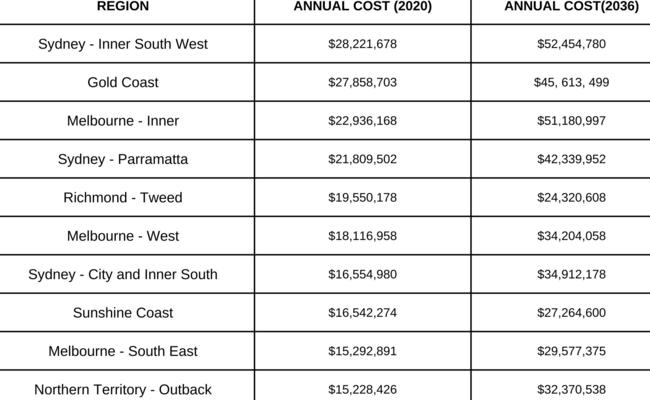
The ten areas with the highest costs associated with a lack of affordable housing, as identified by Dr Nygaard.
Kate Colvin is the national spokeswoman for Everybody’s Home, a campaign whose goal is to “fix the housing crisis”. It was launched back in 2018 by a coalition of housing, homelessness and welfare organisations.
Ms Colvin said Dr Nygaard’s research showed a lack of investment in affordable housing was “pushing Australians into acute stress and dysfunction”.
“The real world impact is extra trips to hospital emergency wards, more psychological counselling, lower school achievement, lower incomes, women and children unable to escape from family violence, and more stress on our police and courts,” she said.
“Our current housing policies are utterly perverse, and we are all paying for it.”
Ms Colvin argued Australia’s policies were “so lopsided” that “we are making our people sick or requiring them to live with violence”.
“Each year, for example, an estimated 7690 women return to (domestic violence) perpetrators because they have nowhere to go, and an estimated 9120 women become homeless,” she said.
“This is a social and economic time bomb that will only be defused by investing in adequate social and affordable housing.
“At least 40 per cent of the population is unlikely to ever have the financial firepower to own a home. Amid skyrocketing rents, the best solution is to provide more options for people on low and modest incomes.”
In last week’s federal budget, the government announced it would expand the scope of existing programs designed to help Australians buy their first home.
READ MORE VIA NEWS.COM.AU
MOST POPULAR IN NEW ZEALAND
 Melissa Caddick’s parents and husband face being HOMELESS | AUSTRALIA
- Simon Bridges’ Tauranga family home passed in at auction | WATCH
- Abandoned land for sale
- ‘Unacceptable’: top real estate agents axed
- Auckland development put up for mortgagee sale
- Fletcher Living, to develop Ellerslie Racecourse
- Star real estate agent – ‘I work 12 hour days, seven days a week | WATCH
- House price boom: Homes owned by Auckland politicians
- NZ winery billionaire whose private jet brought the body of Shane Warne back from Thailand
- Property market downturn sets in | CORELOGIC NZ


